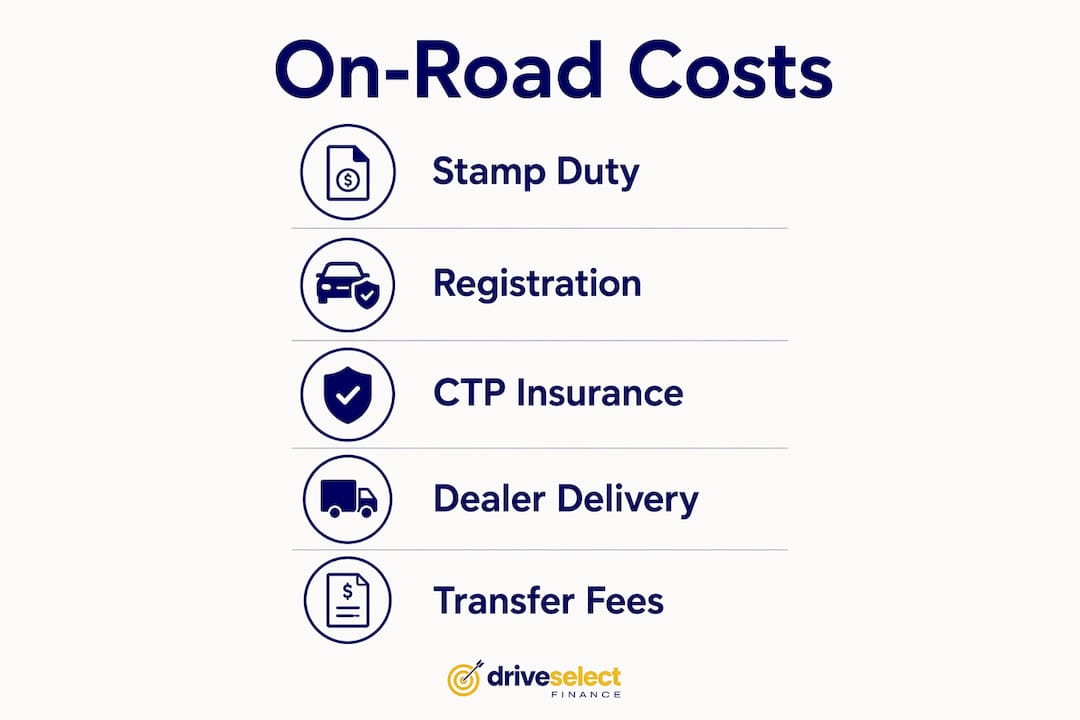
On-road costs are the mandatory fees added to a vehicle's list price that make it legally drivable on Australian roads. These expenses go well beyond the sticker price and typically include stamp duty, registration fees, Compulsory Third Party (CTP) insurance, dealer delivery charges, and transfer fees. The total can add thousands of dollars to what you actually pay. Every Australian buyer, whether purchasing a family sedan or a commercial truck, needs to understand these costs before signing anything.
What is on-road costs: the full breakdown
On-road costs is the informal term for what the industry formally calls "on-road charges" or "on-road fees." These are the government-mandated and dealer-applied expenses required to register and legally operate a vehicle after purchase. Dealer delivery fees alone often add $900 to $2,000 to the total vehicle price. That figure does not include stamp duty, registration, or CTP insurance, which stack on top.
Here is what each component covers:
- Stamp duty: A state government tax calculated as a percentage of the vehicle's purchase price or market value. The rate and calculation method differ by state, so a $40,000 car attracts different stamp duty in Victoria versus Queensland.
- Registration fees: Charged by state transport departments to register the vehicle in your name. The fee depends on vehicle type, weight, and intended use.
- Compulsory Third Party (CTP) insurance: Legally required in every Australian state and territory. CTP covers personal injury claims if you cause an accident. The cost varies by state, insurer, and vehicle class.
- Dealer delivery charges: Fees the dealership charges to prepare the vehicle for handover. This covers things like pre-delivery inspection, fuel, and number plates. These fees are unregulated by government, which means dealers set them freely.
- Transfer fees: Paid when registering a vehicle in your name, particularly relevant for used car purchases. A flat fee applies in most states.
Pro Tip: Ask the dealer to itemize every line in the on-road cost breakdown before you agree to anything. Vague "delivery and handling" charges are often where padding hides.
How do on-road costs vary across Australian states and territories?

No national standard exists for on-road costs in Australia. Each state and territory government independently sets its own registration fees, stamp duty rates, and CTP insurance pricing. This means the total on-road expenses for the exact same vehicle can differ by hundreds or even thousands of dollars depending on where you live.
The table below shows how key cost categories differ across jurisdictions:
| Cost component | Varies by |
|---|---|
| Stamp duty | State rate, vehicle value, and sometimes vehicle type |
| Registration fee | Vehicle weight, engine type, and state schedule |
| CTP insurance | State scheme, insurer, and vehicle class |
| Transfer fee | State flat rate; often around $31 in some jurisdictions |
| Late transfer penalty | Jurisdiction rules; can reach around $105 in some states |
Timing matters more than most buyers realize. Failing to pay the registration transfer fee within the required window, often 14 days, can trigger late penalties that add unnecessary cost. First-time buyers frequently miss this deadline because they focus on the purchase itself and overlook the post-sale paperwork.
Consulting your local state or territory transport department website is the most reliable way to get accurate figures. The Australian Capital Territory, New South Wales, Victoria, Queensland, South Australia, Western Australia, Tasmania, and the Northern Territory each publish their own fee schedules online.
Pro Tip: If you are buying a used car interstate, check both the seller's state fees and your home state's fees. You may need to re-register the vehicle in your state, which triggers a fresh set of charges.
What is the difference between "drive-away" price and "excluding government charges" pricing?
This distinction is one of the most important things a buyer can understand before walking into a dealership. Drive-away pricing includes all mandatory fees and delivery costs, so the number you see is the number you pay. Nothing is added at the end.
"Excluding government charges" pricing is the opposite. The advertised price covers only the base vehicle cost. Stamp duty, registration, CTP insurance, and transfer fees are all added afterward. Buyers who do not read the fine print often face a final invoice that is thousands of dollars higher than the price they saw advertised.
The risks of "excluding government charges" pricing include:
- Unexpected stamp duty: Can add thousands to the final cost, especially on higher-value vehicles.
- CTP insurance surprise: Buyers sometimes assume CTP is included, only to find it listed separately at settlement.
- Dealer delivery on top: Even after government charges are added, the dealer delivery fee may appear as a separate line item.
- Budget blowout: Buyers who arrange financing based on the advertised price may find their loan falls short of the actual purchase cost.
Requesting a drive-away price early in negotiations removes this confusion entirely. It forces the dealer to show you the real number upfront, which makes it far easier to compare offers and arrange the right level of financing. For business buyers using an ABN vehicle loan or equipment finance, knowing the true total cost from the start is critical for accurate loan structuring.
Understanding dealer vs. private sale finance also matters here, because private sales often exclude dealer delivery charges but still carry stamp duty and registration costs.
How to calculate on-road costs before you buy
Calculating your total vehicle costs before purchase protects your budget and prevents financing shortfalls. No universal on-road cost calculator exists in Australia because fees are set independently by each state. You need to use your local government's tools and combine several inputs.
Follow these steps to get an accurate estimate:
- Find your state's stamp duty calculator. Each state transport or revenue office publishes an online calculator. Enter the vehicle's purchase price and type to get the exact duty amount.
- Check the registration fee schedule. Look up your state's fee table based on vehicle weight and class. A passenger car attracts a different fee than a light commercial vehicle.
- Get a CTP insurance quote. In states with a competitive CTP market, such as New South Wales, you can compare insurers. In states with a single government scheme, the price is fixed.
- Confirm the dealer delivery fee in writing. Ask for the exact dollar amount and what it covers. This fee is negotiable, unlike the government charges.
- Add the transfer fee. For used vehicles, include the registration transfer fee and factor in the payment deadline to avoid late penalties.
- Total everything and apply it to your loan amount. Your car loan should cover the full drive-away cost, not just the vehicle's base price.
The factors that affect your total include vehicle type, purchase price, your garaging address, and whether the car is new or used. New vehicles typically include registration and CTP in the drive-away price, while used vehicles often require the buyer to handle transfer and re-registration separately. Understanding how financing costs relate to total vehicle price helps you structure a loan that actually covers everything.
Pro Tip: Use the Driveselectfinance loan calculator to model your repayments based on the full drive-away price, not the base vehicle price. A loan that falls short of the real cost creates a gap you have to cover out of pocket.
Key Takeaways
On-road costs are the mandatory fees beyond a vehicle's list price that every Australian buyer must pay to legally drive their vehicle, and the total varies significantly by state, vehicle type, and dealer.
| Point | Details |
|---|---|
| On-road costs are mandatory | Stamp duty, registration, CTP insurance, and delivery fees are all required to legally drive in Australia. |
| Dealer delivery fees are negotiable | These fees range from $900 to $2,000 and are unregulated, so buyers can push back on inflated amounts. |
| State fees vary significantly | No national standard exists; always check your local government's fee schedule for accurate figures. |
| Drive-away price is the safest number | Always request a drive-away quote to see the true total cost before committing to a purchase. |
| Late transfer penalties add up | Missing the transfer fee deadline can cost around $105 in some states, a preventable expense. |
What I have learned from watching buyers get burned on on-road costs
The most common mistake I see is buyers negotiating hard on the vehicle price and then accepting every on-road charge without question. They save $500 on the car and then pay $800 in an inflated dealer delivery fee they never challenged. Dealer delivery is the one component of on-road expenses that is genuinely negotiable. Government charges are fixed. Dealer prep fees are not.
The second issue is "excluding government charges" advertising. I have seen buyers budget carefully, get pre-approved for a loan based on the advertised price, and then discover at the dealership that their loan is $2,000 to $3,000 short of the actual drive-away cost. That gap either comes out of savings or requires a last-minute loan top-up, which can affect the interest rate. Neither outcome is good.
My firm advice: always ask for the drive-away price in writing before you spend time negotiating anything else. If a dealer is reluctant to provide it, that tells you something. Transparent dealers give you the full number without hesitation. The ones who bury charges in fine print are the ones worth walking away from.
For business buyers, the stakes are higher. On-road costs affect the total asset value you are financing, which flows through to depreciation, GST claims, and loan structuring. Getting the number right from the start is not just about avoiding surprises. It directly affects your tax position.
— Matt
How Driveselectfinance helps you finance the full cost of your vehicle
Understanding your on-road expenses is only half the equation. The other half is making sure your financing covers the complete drive-away price, not just the base vehicle cost.
Driveselectfinance works with a panel of 30+ trusted lenders across Australia to find car loans, ABN vehicle loans, business loans, and personal loans that account for your full purchase cost, including all on-road fees. Whether you are buying a new passenger car, a commercial truck, or a piece of equipment for your business, the right loan structure starts with knowing the real number. Use the Driveselectfinance car loan options to compare rates and get a loan tailored to your actual total cost. Business owners can also explore equipment loan products designed to cover vehicles used for commercial purposes, on-road costs included.
FAQ
What is included in on-road costs in Australia?
On-road costs include stamp duty, vehicle registration fees, Compulsory Third Party (CTP) insurance, dealer delivery charges, and transfer fees. The exact total depends on your state, vehicle type, and purchase price.
Are on-road costs the same in every Australian state?
No. Each state and territory sets its own stamp duty rates, registration fees, and CTP insurance pricing. The same vehicle can cost significantly more to put on the road in one state versus another.
Can I negotiate dealer delivery fees?
Yes. Dealer delivery fees are unregulated and range from $900 to $2,000. Unlike government charges, they are set by the dealership and can be negotiated or reduced.
What does "drive-away" price mean?
A drive-away price includes the vehicle's base cost plus all on-road fees, meaning stamp duty, registration, CTP insurance, transfer fees, and dealer delivery. It is the total amount you pay to drive the car away.
How do on-road costs affect my car loan amount?
Your loan should cover the full drive-away price, not just the vehicle's list price. Financing only the base price leaves a gap that you must cover separately, which can affect your budget and loan structure.